
Load Capacity
Basic dynamic and static ratings for radial and/or axial loads.
Industry reference material from the documents provided for this redesign.
A bearing is a machine element that supports and guides rotating or moving parts, reduces friction and carries radial and/or axial loads.
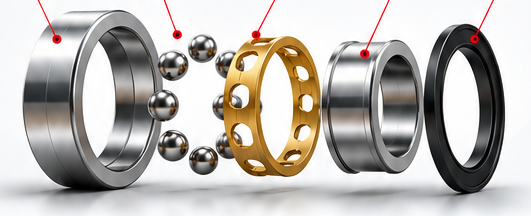
Illustrative exploded view. Component arrangement varies by bearing design.
Different designs for different loads, speeds and operating conditions.
No matching bearing type found. Try a different term.
Important parameters that define bearing performance, fit and service life.
Basic dynamic and static ratings for radial and/or axial loads.
Reference and limiting speeds depend on design and conditions.
Dimensional and running accuracy classes for precise fit.
Internal movement before installation; changes in service.
Rating life is statistical, not a guaranteed service duration.
Match bearing design to operating requirements, not just dimensions.
Radial, axial or combined loads.
Operating RPM and duty cycle.
Allowable misalignment and deflection.
Temperature, lubrication and contamination.
Required reliability and service life.
Correct material, precision manufacturing and proper maintenance all matter.
High-quality bearing steel, appropriate hardening and controlled material properties help resist fatigue and wear.
Raceway finish, dimensional accuracy, cleanliness and quality checks influence performance.
Use correct mounting methods, suitable lubricant and contamination protection to reduce premature damage.
Clear answers to practical questions about selection, care and performance.
◉Metal shields (often Z or ZZ) help keep out larger particles with little contact friction. Contact seals (often RS or 2RS) generally offer better protection against contaminants and lubricant leakage, with additional friction depending on seal design.
No. Operating clearance depends on shaft and housing fits, temperature, load and speed. Too little clearance can cause excessive heat; too much can reduce accuracy and stability.
Start with radial and axial loads, operating speed, shaft alignment, space, temperature, lubrication, contamination and desired rating life. Confirm the choice against a manufacturer's engineering catalogue.
Common contributors include poor lubrication, contamination, improper fitting or mounting, misalignment, excessive loads and electrical erosion. Root-cause analysis should consider operating evidence.
C3 commonly denotes radial internal clearance greater than Normal. 2RS generally indicates contact seals on both sides, but suffix definitions vary by manufacturer.
Choose the correct bearing, fit and lubricant; maintain cleanliness; install with suitable tools; avoid excessive load and misalignment; and monitor temperature, noise and vibration.