
Anti Friction Bearings
Precision rolling elements help moving machinery run smoothly by reducing friction while supporting radial and axial loads.
Engineering motion.
Reducing friction.
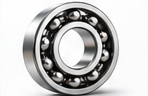
Anti-friction bearings, also called rolling-element bearings, use balls or rollers between inner and outer raceways to support loads and enable relative rotation with less friction than direct sliding contact.
They commonly include rings, rolling elements and a cage or separator. Their performance depends on load, speed, lubrication, sealing, alignment and installation conditions.
How they work
The rolling elements transmit force between the inner and outer rings. A properly selected lubricant reduces wear and protects contacting surfaces.
- Ball or roller elements carry the applied load
- Precision raceways guide the rolling motion
- A cage separates and guides rolling elements in many designs
- Standardized dimensions help with interchangeability
Types of Anti-Friction Bearings
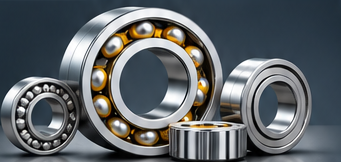
Explore the most common configurations. The exact capacity and speed limits depend on the bearing design and manufacturer.
Ball Bearings
Balls run between shaped raceways. Deep-groove ball bearings can support radial and moderate axial loads; angular-contact designs support combined loads.
- Typical loads
- Radial + design-dependent axial
- Common applications
- Electric motors, fans, pumps
- Key consideration
- Select suitable clearance, sealing and lubrication
Find the right configuration
General comparison for learning purposes, not a substitute for manufacturer load ratings.
| Bearing family | Primary strength | Load direction | Typical applications |
|---|---|---|---|
| Deep-groove ball | Versatile, low friction | Radial + moderate axial | Motors, pumps, fans |
| Angular-contact ball | Combined load capability | Radial + axial in one direction per row | Spindles, precision machinery |
| Cylindrical roller | High radial capacity | Primarily radial | Gearboxes, industrial motors |
| Tapered roller | Combined heavy loads | Radial + axial | Wheel hubs, gearboxes |
| Thrust ball | Axial load support | Primarily axial | Vertical shaft arrangements |
Why rolling-element
bearings matter
- Reduce friction relative to many sliding contacts
- Support specified radial or axial loads
- Enable compact, standardized mechanical designs
- Offer predictable rating-life calculations under defined assumptions
Actual bearing life depends on operating conditions, contamination, lubrication, mounting and fatigue.
Frequently asked questions
Useful answers for engineers, buyers and maintenance teams.
◉Are anti-friction bearings completely frictionless?
No. They reduce friction by using rolling elements, but still experience contact, lubricant and seal-related losses.
What is the difference between ball and roller bearings?
Ball bearings use spherical rolling elements and are often suitable for higher-speed, lower-friction applications. Roller bearings use cylindrical, tapered, spherical or needle-shaped rollers and often provide higher load capacity for their size.
Do all anti-friction bearings require lubrication?
Most do. Some sealed bearings are pre-lubricated, while other designs require periodic grease or oil supply. Follow the manufacturer's instructions.
How is bearing life estimated?
Engineers commonly use ISO 281 rating-life methods alongside manufacturer data. Actual service life can differ due to lubrication, contamination, load and installation.